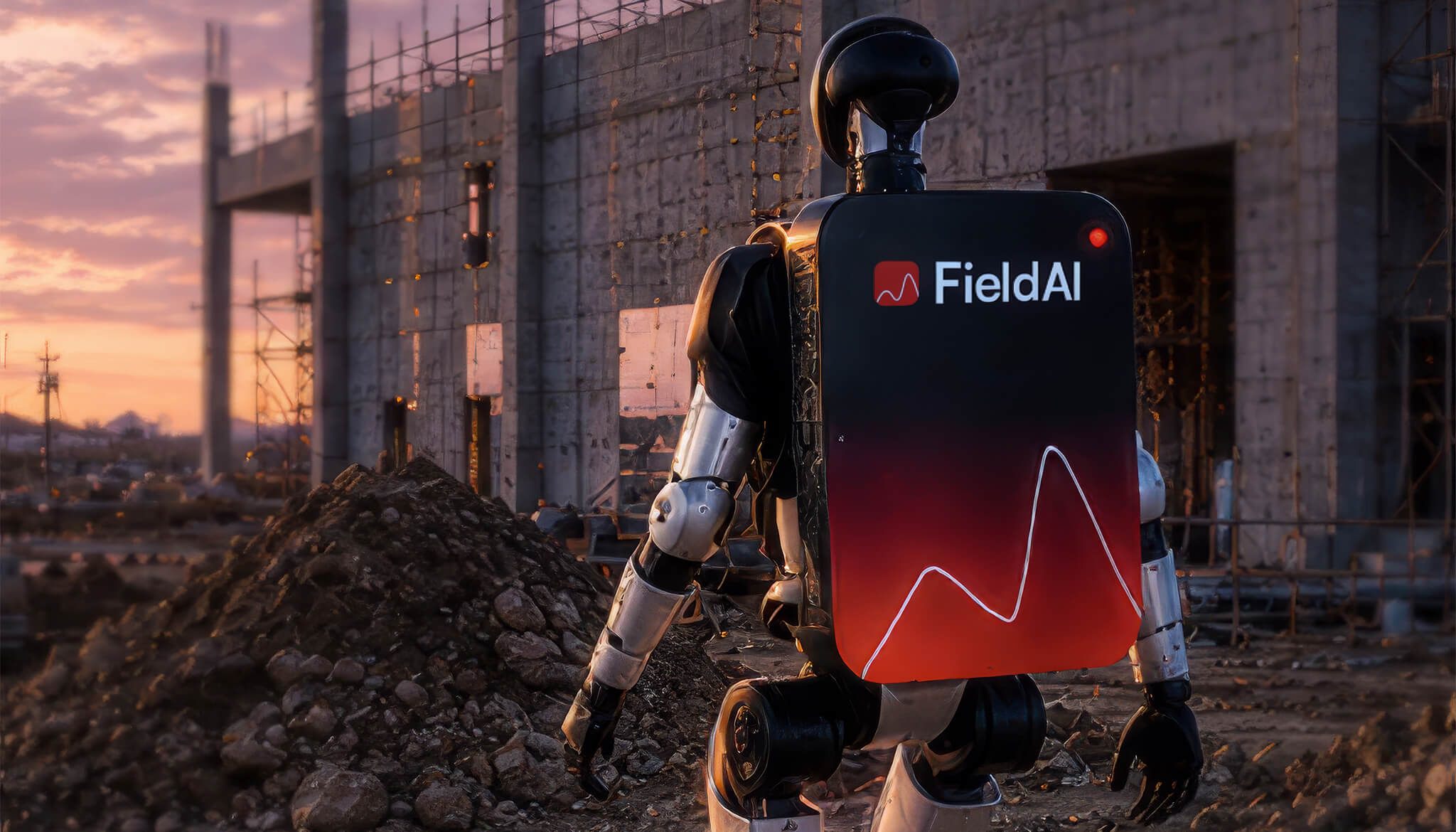

About FieldAI: An embodied-AI company building the intelligence layer that helps robots operate safely in the changing, imperfect environments where real work happens.
The old robotics bargain was to control the world first
For decades, the most reliable way to use robots was to make the environment easier for them. Factories were organized around fixed stations and repeatable motions. Warehouses were redesigned to reduce surprise. Many autonomous systems depended on known maps, clear routes, and tightly defined tasks.
So robotics became powerful in controlled settings and much harder everywhere else. The industry learned to narrow the problem: give the machine a clean route, a stable map, and a specific job. The trouble is that many of the most valuable environments are not stable. They are unfinished, hazardous, crowded, remote, or changing too quickly for the old playbook to hold.
FieldAI starts where the map runs out
The easiest way to explain FieldAI is that it is building the “brain” that helps robots handle uncertainty.
At the center of the company’s platform are Field Foundation Models, AI models designed for the physical world. They are built to account for physics, motion, risk, and real-time decision-making rather than simply adapting language or vision models to robotics after the fact. The system can use inputs from cameras, LiDAR, radar, and inertial sensors to help a robot understand its surroundings. It can run on edge devices, which means the robot can make decisions directly instead of relying on a cloud connection.
FieldAI is also taking a practical approach to adoption. Its software and sensor-compute payload can be used to retrofit existing robots, rather than forcing customers to replace entire fleets. That is a meaningful detail because industrial automation only spreads when it can fit into real operating constraints.
The difference is risk, not spectacle
FieldAI’s most important choice may be that it treats uncertainty as the starting point.
A lot of automation works by assuming the world will behave within a narrow range. FieldAI is building for places where that assumption is not safe. Its system is designed to be risk-aware, meaning it evaluates confidence and operates within safety thresholds. For industrial customers, that is not a technical detail. It is the difference between a robot that can be trusted in the field and one that only works in a controlled demo.
The company is also building across robot forms. A quadruped, a humanoid, a wheeled robot, and an autonomous vehicle may look different, but the underlying autonomy problems often rhyme: perception, planning, safety, adaptation, and movement through changing spaces. FieldAI’s view is that different machines should be able to share a more capable intelligence layer.
That is the deeper idea. The biggest bottleneck in robotics may not be the robot body. It may be the software layer that allows many kinds of machines to work safely outside the lab.
Why this matters beyond robotics
Most people do not need to care about robotics as a category. They do need to care about the physical systems robotics could help improve.
Construction sites need better visibility into what has changed. Energy and utility operators need safer ways to inspect hazardous places. Logistics teams need clearer views of moving environments. Mines, factories, and industrial facilities need ways to collect information without sending people into every difficult or dangerous area.
The human layer is straightforward. A project engineer should not have to spend hours repeatedly walking the same site just to understand what changed. An inspector should not have to enter every risky area manually. An operator should not have to make decisions with stale or incomplete information if a machine can safely gather more of the picture.
This is why FieldAI matters outside robotics. If machines can safely operate in the field, they can help people see more, risk less, and act sooner. That is not the flashy version of the robotics story. It may be the more important one.
The real question
The question FieldAI is asking is not simply whether robots can move through rough environments. It is whether autonomy can finally leave the controlled world and become useful in the physical one.
For years, the gap between robotics demos and robotics deployments has been one of the industry’s hardest problems. FieldAI is building into that gap with a practical, risk-aware intelligence layer designed for the world as it actually is.
That is what makes the company important to us at Canaan. Not the theater of a perfect demo, and not robots in the abstract. The importance is in the harder work underneath: helping machines operate safely where work actually happens, so the people building, inspecting, powering, and maintaining the world can do that work with better tools, better information, and less unnecessary risk.