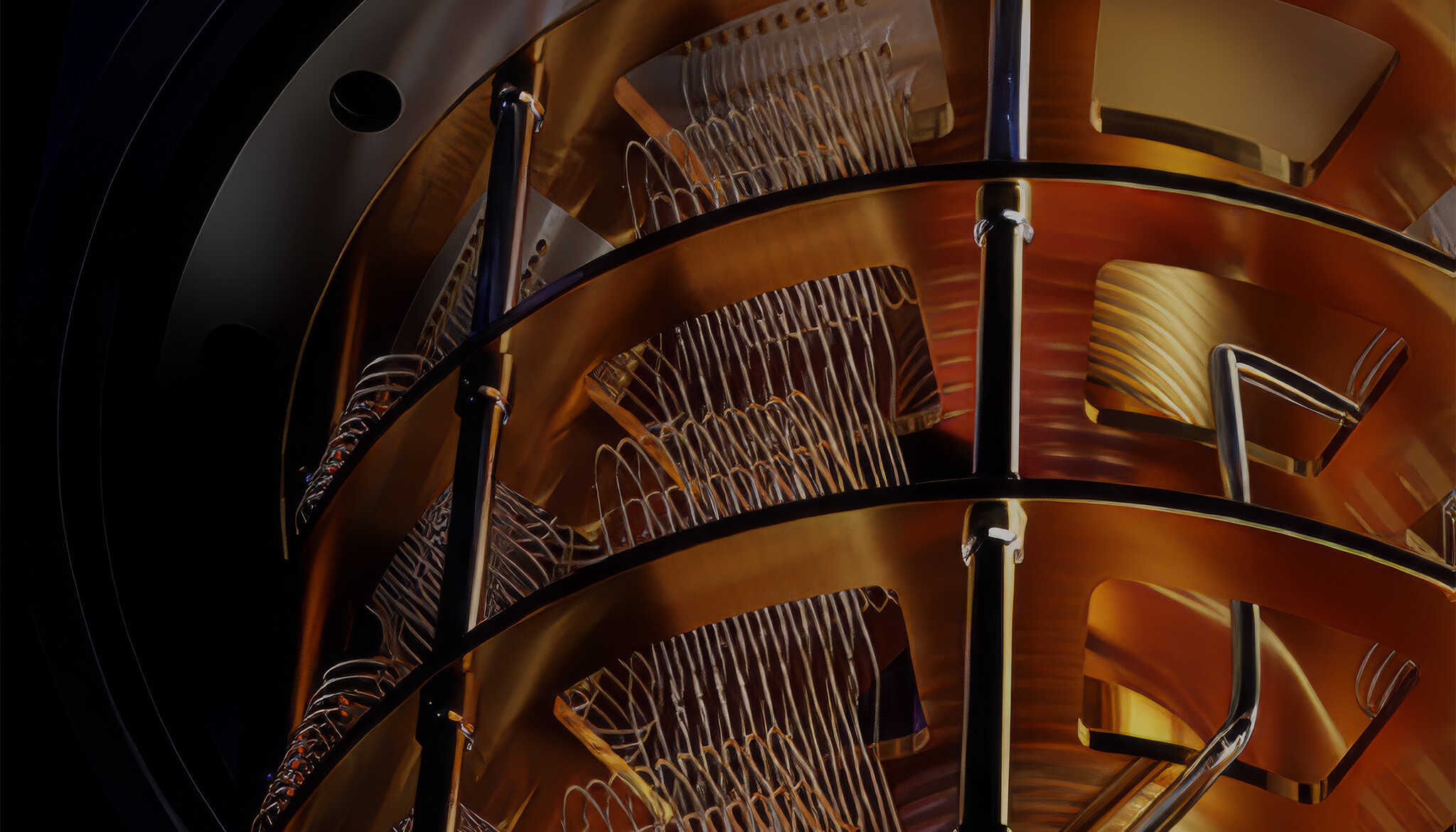

About Quantum Circuits: A quantum-computing company built around a harder standard: not how many qubits a machine can hold, but whether those qubits can produce results people can trust.
Why did we invest?
The first reason was the team. Rob Schoelkopf and his co-founders at Yale had helped invent the foundation of superconducting quantum computing, the same general approach that major technology companies including IBM, Amazon, and Google went on to pursue. Michel Devoret later received the 2025 Nobel Prize in Physics for his contributions to the field. What stood out to us was not only the depth of the science, but how practically the team was thinking about commercialization. They were already focused on modular design, scalability, applications, and the engineering required to move the technology out of the lab.
The second was what Canaan partner Brendan Dickinson has described as the team’s “earned secret.” In 2017, the conversation around quantum computing was dominated by qubit counts, system size, and demonstrations. QCI’s view was that none of those metrics mattered if the machine could not produce a reliable computation. Accuracy had to precede scale. Architecture had to precede applications.
At the time, that emphasis on error correction was not universally embraced. Years later, it has become central to serious fault-tolerant quantum roadmaps. Quantum computing does not move on software timelines, and meaningful advances require the willingness to work on constraints that may look unfashionable before they look inevitable.
Quantum systems are highly sensitive to vibration, temperature, radio interference, and other environmental factors, making fault tolerance far harder than in classical computing. Error correction is therefore less like a finishing feature and more like the central engineering problem.
Quantum Circuits started with the failure mode
Instead of building a large collection of conventional qubits and planning to handle errors later, Quantum Circuits designed its hardware so it could detect common errors as they happened.
Its core technology is the Dual-Rail Cavity Qubit. In plain English, each qubit stores quantum information across a pair of superconducting microwave cavities. When the system loses a photon, one of the dominant failure modes in this architecture, the hardware can often recognize that something went wrong and identify where the error occurred.
A hidden error is hard to correct because the system first has to determine whether something failed and where. An “erasure” error is more manageable because the machine knows the location of the problem. QCI carried that approach into Aqumen Seeker, an eight Dual-Rail Qubit system accessible through the cloud, with software that lets developers work directly with error information while an algorithm is running.
Why now is different
The quantum industry is reaching the point where demonstrations alone are no longer enough. Researchers and companies increasingly need systems that can run deeper calculations repeatedly and eventually support fault-tolerant operation.
That shift makes the architecture underneath the qubit more important than headline scale. In 2025, QCI also integrated with NVIDIA CUDA-Q, connecting its error-aware hardware with a broader hybrid quantum-classical software environment.
Why this matters beyond quantum computing
Most people will never program a quantum computer, and they should not need to understand cavity physics to benefit from one.
The promise is that certain calculations in areas such as chemistry, materials, optimization, and machine learning may eventually become tractable in ways they are not today. None of that matters if the machine cannot produce dependable results. Reliability is the bridge between an extraordinary scientific object and a useful computing system.
The real question
The question Quantum Circuits has been asking is not simply whether we can build more qubits. It is whether we can build quantum machines whose mistakes are visible and correctable enough for scale to finally mean something.
QCI’s next chapter is now unfolding inside D-Wave, where its architecture can continue toward the goal that animated the company: practical quantum computing. What has stayed with us over nine years is the discipline of the original thesis. We did not need to predict exactly when quantum computing would arrive. We needed to understand what had to be true for it to arrive at all.